

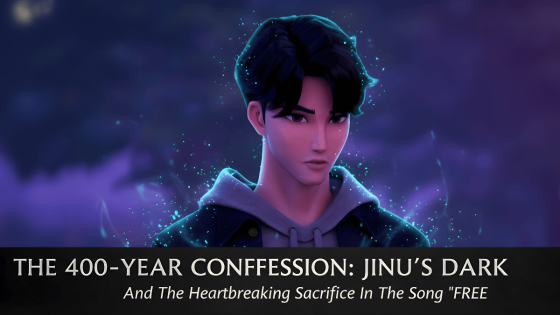
If you’ve ever watched KPop Demon Hunters, you know it’s a whirlwind of stunning choreography, dazzling golden costume aesthetics, and high-stakes action. But beneath the surface of the glitter and the fierce demon-slaying, the film hides one of the most poignant and tragic love stories in recent animated history—the relationship between Rumi, the star of Huntrix, and Jinu, the conflicted leader of the Saja Boys.
For much of the film, Jinu appears as the ultimate villain: manipulative, charming, and dedicated to undermining the rumi zoey mira trio. Yet, his motives were never purely evil. They were rooted in a devastating personal quest—a mission to erase four centuries of agonizing shame.
Why did a character dedicated to destroying the golden honmoon end up making the ultimate sacrifice for the girl he was supposed to defeat? Why did the melancholic beauty of the rumi song ‘Free’ become his final, heartbreaking confession? We’re diving deep into the soul of Jinu kpop demon hunter—the B-Story hero whose darkness ultimately paved the way for Rumi’s light.
Jinu: The Villain Who Only Wanted Silence
When we first meet Jinu, he embodies the perfect rival kpop idol. He’s charismatic, dangerous, and leads the terrifyingly talented Saja Boys. But unlike his demon master, Gwi-Ma, Jinu isn’t driven by a lust for power or eternal life. His true desire is simple, and far more tragic: he wants oblivion.
The Burden of 400 Years of Shame
The core tragedy of Jinu’s existence is revealed late in the film, but it defines every choice he makes. Jinu carries the crippling burden of 400 years of shame for a terrible, selfish act: he abandoned his demon family in their time of need. This original sin has left him haunted, filled with constant self-loathing, and perpetually hearing the shaming voice of Gwi-Ma in his head.
Jinu’s deal with Gwi-Ma wasn’t for victory or glory. His single request in exchange for helping destroy Huntrix was the erasure of his own memories. His goal wasn’t to conquer the human world; it was to simply cease being who he was. This desperation makes him the ultimate ‘B Story’ figure—the supporting character whose personal struggle perfectly mirrors and illuminates the hero’s path.
The Weaponization of KPop Demon Hunters Songs
To achieve his tragic goal, Jinu had to orchestrate a sabotage plan against Huntrix. His strategy was brilliant and terrifying: rather than fighting Huntrix, the Saja Boys would steal their fans. The Hunters’ power—the Honmoon shield—depended on the unified love and voices of their fans. If Jinu could divide the fandom, the shield would crumble, and Huntrix would fail to achieve the Golden Honmoon.
The Saja Boys used their music as a literal weapon. Their hypnotic anthem, kpop demon hunters songs your idol, was a dark, manipulative siren call. The song’s kpop demon hunters song lyrics essentially told the fans: “I’m going to be your idol. I’m going to rule you. You are no longer powerful. You are powerless.” This was not merely K-Pop rivalry; it was mind control designed to funnel masses of fans directly into Gwi-Ma’s soul-harvesting trap.
This plot perfectly sets up the central conflict: while Rumi fights to unite through genuine love, Jinu fights to divide through shame and manipulation, making their eventual connection all the more profound.
The Intersection: Rumi’s Broken Voice Meets Jinu’s Broken Soul
The narrative genius of KPop Demon Hunters lies in how it interweaves Rumi’s external battles with Jinu’s internal conflict. Rumi’s story is a “Rites of Passage,” a journey of accepting a difficult truth, and Jinu is the catalyst that forces her to face it.
Rumi’s Concealment: The Wrong Way to Heal
Like Jinu, Rumi was consumed by shame. Her shame stemmed from her half-demon heritage, visualized by the dark, intricate demonic patterns spreading across her skin. Her “wrong way” of dealing with this life problem was rigid concealment. Rumi was terrified that if she revealed her true nature—the darkness within—she would lose her friends and, more importantly, lose the power in her voice.
Ironically, the act of hiding her shame made it grow and fester until the one thing that gave her purpose—her phenomenal rumi song voice—began to fail. She was caught in an impossible bind: if she couldn’t sing, Huntrix couldn’t save the world; if she told the truth, she risked losing her chosen family, Mira and Zoey.
The Midpoint Collision and the Revealed Secret
The paths of Rumi kpop demon hunters and Jinu clash repeatedly, but the most crucial moment happens during a chaotic chase. Rumi’s sleeve is ripped, exposing the horrifying demonic patterns on her arm.
What does the villain do? He doesn’t expose her. He doesn’t mock her. Jinu quickly covers her arm before Mira and Zoey can see, leaving Rumi utterly confused. Why would her sworn enemy protect her secret?
This single action reveals the heart of Jinu: his cruelty was a mask for his own self-loathing. He recognized the pattern of shame in Rumi because it was his own pattern, intensified by 400 years of regret. He saw Rumi’s hidden scar and, in that moment, he protected the girl he was supposed to hate, because he was desperately protecting his own painful reflection. This emotional convergence is what makes Jinu one of the most complex and beloved characters in the film, inspiring countless jinu wallpaper and jinu and rumi wallpaper fan creations.
‘Free’: The Song That Healed, Not Halted
The emotional tension boils over when Rumi and Jinu meet again. This conversation is arguably the single most important scene in the movie, serving as the bridge between Rumi’s internal crisis (the B Story) and the external final battle (the A Story).
Lyrical Analysis: When Shame Becomes Power
In a moment of raw vulnerability, Rumi confesses her fear to Jinu: “I spent my whole life hiding this secret, this shame of what I am… and the more I hid that shame, the more it grew and swelled until it started to destroy the one thing that gave me purpose, which was my voice.”
And then, the breakthrough: Rumi tells the demon that talking to him healed her voice. This single line proves the thematic premise of the Rites of Passage story: the problem wasn’t the demon part; the problem was the shame. Jinu, the ultimate source of negative emotion in the narrative, inadvertently provided the cure.
This realization leads directly to the duet, “Free”, which is a masterpiece of musical storytelling.
- Jinu’s Confession: The song is a quiet, powerful admission of Jinu’s pain. He is finally facing the source of his shame after 400 years. The fact that he sings it with Rumi—the girl who understands his shame—is his first true step toward atonement.
- Rumi’s Acceptance: The song solidifies Rumi’s determination to accept her whole self, realizing that only by integrating her “dark” side can she achieve her ultimate power. The moment she accepts her identity, the shame is gone, and her voice is restored.
The sheer power of this emotional connection between the hero and the villain is why the kpop demon hunters song ‘Free’ remains a highly sought-after track, often searched for alongside kpop demon hunters song lyrics and even versions for the kpop demon hunters piano game.
Jinu’s Lament and the Path to Atonement
For fans who dove into the Deluxe version of the kpop demon hunters song cd soundtrack, the bonus track Jinu’s Lament offers even deeper insight. This track is a direct echo of his 400 years of regret. The raw, mournful nature of the song underscores the fact that Jinu was never truly malicious; he was just broken.
This deeper context makes his role in the finale resonate even more powerfully. His ultimate fate—being sacrificed for Rumi—isn’t a cruel twist; it is the only way Jinu could truly become free from the centuries of self-hatred that defined his existence.
The Ultimate Sacrifice: Atonement in the Climax
The final showdown takes place as Rumi steps into the realm of synthesis, embracing the “Dark and Light” idea she and Jinu discussed. She casts aside her shame and unleashes the power of her heritage—the moment we see the stunning Queen Rumi in Battle Mode with her glowing demonic marks. Her transformation is complete.
However, Gwi-Ma, the Demon King, is a formidable enemy. Just as he lunges for Rumi to steal her soul and ensure the destruction of the golden honmoon, Jinu steps in.
A Soul for a Savior
In a breathtaking flash of light, Jinu sacrifices himself for Rumi, giving her his own saved soul to increase her power. This is the culmination of his B Story arc.
- The Exchange: Jinu gives Rumi his soul, ensuring she has the strength to defeat Gwi-Ma.
- The Confession: As Gwi-Ma drags him back into the demon realm, Jinu manages a final, simple act of contrition, asking Rumi to forgive him for everything he did.
Jinu, who only wanted his memories erased and to escape the shame of his past, finds his only path to “Free” through this supreme act of love and sacrifice. It is the final, undeniable proof that the theme stated early in the film—acceptance is the solution—is true for both the hero and the antagonist. Rumi is saved and empowered; Jinu is finally, tragically, free.
This monumental emotional moment is why the KPop Demon Hunters fandom continues to revisit and debate the fate of Jinu. It elevates the film beyond a simple K-Pop action flick into a profound mythological urban fantasy.
The Jinu Legacy: Impact on the Rumi Zoey Mira Aesthetic
Although Jinu is gone (for now—fans are desperate for his return in a sequel!), his emotional legacy is woven into the aesthetic and themes embraced by the rumi zoey mira trio.
The Dark Aesthetic and Fan Engagement
Jinu’s signature look—the black leather, the stylish jinu demon jacket, and his often somber expressions—remains incredibly popular. Fans love the duality he represents: the stylish idol exterior masking a profound internal darkness.
This aesthetic is highly sought after in the fandom community:
- Cosplay & Fashion: Cosplayers often choose Jinu costume boys outfits, admiring the blend of K-Pop fashion and demon lore. They look for detailed accessories, like his hypothetical jinu earrings, to perfect the look.
- Gaming: Jinu’s theme and songs are essential components of fan-made entertainment like the kpop demon hunters piano game and kpop demon hunters magic tiles. The emotional weight of his story provides the perfect backdrop for games and music apps, keeping the character relevant long after the film’s release. The jinu and rumi connection fuels the entire gaming sector surrounding the film.
The Triumph of Complete Power
Jinu’s sacrifice directly empowers Rumi. With his soul adding to her strength, she finally channels the raw energy of her complete heritage. This is the moment Mira and Zoey finally see the full power of their leader, symbolized by the glowing patterns that now make Rumi look invincible.
The unity of rumi zoey mira at the end is absolute, largely thanks to Jinu’s final act. They become the complete force needed to finish the battle, with Zoey using her zoey shin kal weapons and Mira mastering the choreography, all under the shield Rumi now strengthens. Fans often look for kpop demon hunters wallpaper zoey or mira kpop demon hunters wallpaper alongside Rumi’s Battle Mode, recognizing that the trio’s strength is now indivisible.
Engaging the Fandom: How Jinu Elevates KPop Demon Hunters Games and Lore (Continued)
The ongoing impact of Jinu’s character extends deep into the fan community’s creativity and lore exploration. The richness of his story is why KPop Demon Hunters has generated such intense and diverse fan-created content.
The Role of Fan Imagination
The questions left unanswered by Jinu’s fate drive much of the fan theorizing and engagement. Did his soul truly vanish, or is he now part of Rumi’s internal strength? This is why searches for rumi and jinu remain high, sparking speculation in various formats:
- Roleplay & Storytelling: Many fans participate in kpop demon hunters rp (roleplay) scenarios that explore Jinu’s time in the demon realm or his possible return. The community delves into hypothetical kpop demon hunters lyrics for Jinu’s new songs, imagining what his voice would sound like now that he is truly “Free.”
- Merchandise & Art: From creating jinu wallpaper to producing kpop demon hunters coloring books and even complex ar drawing kpop demon hunters tutorials, the fandom is constantly celebrating his visual identity. Fans buy accessories like the kpop demon hunters jinu keychain or even try to recreate his intense makeup looks.
- The Digital Universe: The success of KPop Demon Hunters has spawned many digital fan activities, including the kpop demon hunters games genre. These games, ranging from simple kpop demon hunters song game rhythm challenges to more complex kpop demon hunters juego (games) that mimic the film’s combat, rely heavily on the emotional soundtrack, making Jinu’s tracks central to the player experience. Whether it’s a kpop demon hunter song tiles game or a kpop demon hunters puzzle, his contribution is undeniable.
The Legacy of Shame and Acceptance
Ultimately, Jinu’s 400-year confession and sacrifice provided the rumi zoey mira group with the final piece of the thematic puzzle. His story, the B-Story, taught the A-Story hero that the solution was always within—in self-acceptance—rather than in fighting the external world.
The deep emotional investment in this character is what cements KPop Demon Hunters as a phenomenon. It is a movie that understands that even in a world of pop stars and demons, the deepest scars are always the invisible ones. And sometimes, the ultimate act of love is the one that sets the villain free.
Conclusion: The Quiet Hero Who Found His Voice
Jinu was never destined to wear the rumi kpop demon hunters golden costume or stand beneath the completed Golden Honmoon. His destiny was far more painful, yet far more profound. He was the dark mirror that Rumi needed to look into to find her own light.
His desperate quest for memory erasure was a journey toward freedom, a freedom he only achieved by willingly embracing the ultimate sacrifice. He died with no more shame, granting himself the peace he had sought for centuries.
The tragedy of Jinu remains one of the most powerful elements of KPop Demon Hunters. Every time you listen to the rumi song ‘Free’, remember the quiet demon who protected the girl he was supposed to betray and, in doing so, finally saved himself. His sacrifice ensured that the rumi zoey mira trinity could stand strong, ready to face the challenges ahead, knowing that even the darkest soul can find salvation through acceptance and love. The enduring popularity of his story, from kpop demon hunters wallpaper to the competitive kpop demon hunters games, proves that true heroism can come from the most unexpected places.

روايات بدون إنترنت
اقرأ رواياتك المفضلة في أي وقت وأي مكان
هل أعجبتك هذه الرواية؟ يمكنك الآن الاستمتاع بقراءة هذه الرواية وآلاف الروايات الأخرى بدون إنترنت من خلال تطبيقنا المجاني!