

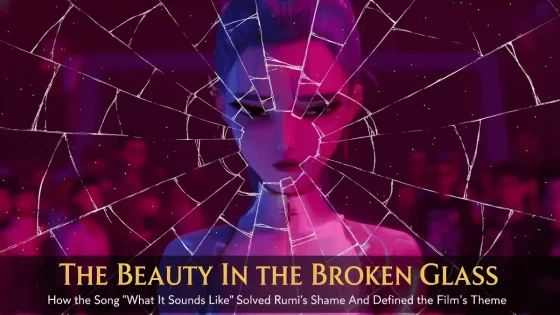
The Beauty in the Broken Glass The Beauty in the Broken Glass The final, climactic scene of KPop Demon Hunters is a visual feast: Rumi, transformed, wielding her r rumi sword with fierce confidence; Jinu making his ultimate, tragic sacrifice; and the portals to the demon realm finally sealing shut. Yet, the emotional truth of that victory isn’t found in the action; it’s found in the lyrics of the final anthem: ‘What It Sounds Like.’
This rumi song, sung by the reunited rumi zoey mira trinity, serves as more than just a powerful battle track. It is the definitive thematic premise of the entire film, providing the answer to the crisis that nearly destroyed Rumi, her friendships, and the Honmoon shield itself.
Think back to the beginning: Rumi was consumed by shame over the demonic patterns on her skin, believing her half-demon heritage was a flaw she had to conceal. This secrecy broke the trust of Mira and Zoey and caused her magnificent voice to fail.
So, how did Rumi go from being broken by shame to declaring, “I see all the beauty in the broken glass”? We are diving deep into the kpop demon hunters song lyrics of ‘What It Sounds Like,’ analyzing how this single track summarizes the painful journey of self-acceptance and establishes the ultimate theme of the film: The solution is always accepting ourselves, scars and all.
The Beauty in the Broken Glass
I. The Silence of Shame: Rumi’s Broken Rites of Passage
The The Beauty in the Broken Glass of KPop Demon Hunters is built on the “Rites of Passage” narrative structure, which dictates that the hero must learn the hard way that she must change, not the world around her. Rumi’s journey was complicated by the trauma of her secret.
The Problem: Concealment as Self-Poison
Rumi’s central “life problem” was the existence of her demonic patterns, which she viewed as a source of deep shame. The “Wrong Way” she chose to handle this was concealment, following the outdated, fear-based philosophy of her guardian, Celine.
- The Muted Melody: The The Beauty in the Broken Glass makes the consequence of this shame crystal clear: “the more I hid that shame, the more it grew and swelled until it started to destroy the one thing that gave me purpose, which was my voice”. Her magnificent rumi song voice, the source of the Honmoon’s power, was muted by the lie.
- The Fractured Trinity: Rumi’s secrecy caused the schism with Mira and Zoey. Her inability to trust her friends led her to lash out at Mira, shattering the cohesion that the KPop Demon Hunters needed to maintain their defense against the Saja Boys.
This inner turmoil is the invisible enemy that Gwi-Ma exploited through the deceptive kpop demon hunters songs like ‘Your Idol’ , proving that their greatest weakness wasn’t a lack of power, but a lack of honesty.
The Climax of Confession: Jinu as the Catalyst
The Beauty in the Broken Glass The critical turning point—the moment Rumi found the “Solution”—occurred during her conversation with Jinu, the tragic villain. By confessing her shame to Jinu—the one person who could truly understand her self-loathing—Rumi broke the curse of secrecy.
- The Healing Meeting: Rumi realized that simply speaking the truth—telling Jinu that she spent her whole life hiding her shame—healed her voice. The power came not from magic or her r rumi sword, but from acceptance.
- The Musical Bridge: The subsequent duet, ‘Free,’ sung by Jinu and Rumi, was the sound of their shared emotional release. It sealed Rumi’s healing and paved the way for Jinu’s final, sacrificial act of atonement, which further empowered Rumi.
This emotional journey leads directly into the final anthem, where Rumi uses the power of her restored voice to declare her full self-acceptance.
II. The Thematic Premise Made Audible: Dissecting the Lyrics
‘What It Sounds Like’ is more than just a song; it’s Rumi’s final, triumphant answer to the initial thematic question posed in the film’s opening anthem, ‘How It’s Done’: “until the dark and the light meet”. The final verses are the poetic conclusion to Rumi’s entire Rites of Passage.
The Verse: The Confession of Imperfection
The opening verses of the finale are a raw confession of Rumi’s past mistakes and her realization of the cost of concealment:
Nothing but the truth now Nothing but a proof of what I am The worst that I came from Patterns I feel shame from Things I don’t even understand Tried to fix it Tried to fight it My head was twisted My heart divided
- The Acknowledgment of Shame: Rumi explicitly names the demonic patterns (“Patterns I feel shame from”) and the source of her internal conflict (“My head was twisted / My heart divided”). This is Rumi finally accepting the “worst that I came from”.
- The Rejection of the Wrong Way: The The Beauty in the Broken Glass “Tried to fix it / Tried to fight it” are a direct lyrical rejection of the “Wrong Way” she and Mira had employed—aggressive suppression, symbolized by the hateful lyrics of ‘Takedown’. Rumi acknowledges that fighting her true self was the mistake.
- The Restoration of Trust: “I don’t know why I didn’t / Trust you to be by my side” is Rumi’s final apology to Mira and Zoey for the lack of trust that shattered the rumi zoey mira bond on the train.
The Climax: Beauty in the Broken Glass
The Beauty in the Broken Glass climax is the most powerful thematic statement of the entire film:
I broke into a million pieces And I can’t go back But now I see all the beauty In the broken glass The scars are a part of me The dark and…
- Acceptance is The Beauty in the Broken Glass: “The scars are a part of me” is the final, definitive affirmation of the Rites of Passage solution: acceptance. Rumi realizes that the demonic patterns are not ugly flaws to be hidden, but essential components of her power.
- Thematic Synthesis: The phrase “The beauty in the broken glass” is the perfect metaphor for the film’s conclusion. Rumi acknowledges she is broken (“I broke into a million pieces”), but the resulting mosaic—the whole, combined person—is more beautiful and powerful than the unattainable perfection she sought (the flawlessness symbolized by the Golden Honmoon).
III. The Musical Proof: The Leit Motif and Golden Glory
The song’s structure and musical cues provide undeniable proof of Rumi’s healing, solidifying the emotional impact for audiences who track every beat of the kpop demon hunters songs soundtrack.
The Leit Motif: The Golden Callback
In music analysis, a Leit Motif is a recurring melody associated with a specific idea or character. The director used this technique brilliantly to signal Rumi’s healing:
- The Shameful Melody: The melody of Rumi’s early song ‘Golden’ was initially associated with the impossible standards and the voice failure that stemmed from her shame.
- The Triumphant Return: During the chorus of ‘What It Sounds Like’, when the crowd chants, a series of “Oh”s uses the exact same melody from ‘Golden’. This musical callback proves that the tune which once symbolized her shame has now been reclaimed and transformed into a powerful anthem of self-acceptance and unity. The melody of her failure is now the sound of her victory.
The Visual Climax: Golden Marks and Cosmic Power
The restored song powers Rumi’s visual transformation. As she sings this final anthem, she enters her fully empowered state, which is visually confirmed by the glowing demonic marks on her skin.
- The Ultimate Aesthetic: The formerly shameful patterns ignite with a brilliant, golden light, marking her as Queen Rumi in Battle Mode. This is the physical realization of the rumi song lyrics—the darkness and the light have met, and the scar has become a source of celestial power. This powerful, contrastive aesthetic is what makes the kpop demon hunters wallpaper of this scene so popular.
- The Unity of Trinity: The song completes the unity of the rumi zoey mira trinity. Mira and Zoey’s jackets acquire matching patterns, symbolizing that Rumi’s truth has healed the division that Mystery Saja and the Saja Boys tried to create through their deceptive kpop demon hunters songs your idol.
IV. The Digital Echo: Songs in KPop Demon Hunters Games
The thematic power of ‘What It Sounds Like’ ensures its legacy within the digital and interactive fandom, driving high search volume for all kpop demon hunters games and content related to the final battle.
Gaming and Emotional Challenge
Rhythm games based on the film, such as kpop demon hunters magic tiles and kpop demon hunters piano game, rely on the dynamic difficulty of the soundtrack. ‘What It Sounds Like’, as the final battle track, is one of the most challenging, reflecting the intense emotional and physical difficulty of Rumi’s breakthrough.
- Fan Engagement: The complex kpop demon hunter song tiles and high-speed rhythms challenge players across all platforms (from simple kpop demon hunters games to detailed juegos de rumi mira zoey). Mastering the song allows the player to symbolically complete Rumi’s Rites of Passage journey.
- Merch and Aesthetic: The emotional weight of the song drives the demand for high-value aesthetic items related to the final scene, such as the rumi kpop demon hunters golden costume and mira zoey rumi costume kids replicas, which symbolize the unity achieved through the song. Even simple phone customizations like kpop demon hunters ring tone often use the powerful chorus of the final track.
Creating the Theme: Art and Wallpaper Synthesis
Artists rely on the synthesis achieved in the final song to create the most authentic kpop demon hunters art.
- Emotional Depth: Tutorials on how to draw rumi and kpop demon hunters drawing guides emphasize the dual lighting required to show the golden glow of Rumi’s marks against the intense darkness, reflecting the “dark and light meet” theme of the song. The image is one of perfect, achieved synthesis.
- The Scars of Jinu: Even Jinu’s tragic sacrifice is musically linked to the song, providing the final burst of emotional power needed. Fans creating jinu wallpaper or rumi and jinu wallpaper often pair them with lyrics from ‘Free’ or ‘What It Sounds Like,’ recognizing the shared thematic resolution.
V. Conclusion: The Final Victory of Authenticity
‘What It Sounds Like’ is the beautiful, broken anthem of ultimate self-acceptance. It is the core message of KPop Demon Hunters, proving that the shame Rumi carried was a far greater threat than any demon.
By confessing her truth and choosing to see the beauty in the broken glass, Rumi restored her voice and unleashed her power, completing her personal journey. However, the mission for the Golden Honmoon remains incomplete—a lingering flaw that demands a sequel.
The rumi song serves as the unbreakable foundation for the rumi zoey mira trinity as they face future threats like Mystery Saja. The song is their constitution, their core belief, forever affirming that their greatest strength lies not in their kpop glamour or their kpop demon hunters leather gear, but in the fearless, unified truth of who they are, scars and all. The sound of acceptance is the sound of the future.

روايات بدون إنترنت
اقرأ رواياتك المفضلة في أي وقت وأي مكان
هل أعجبتك هذه الرواية؟ يمكنك الآن الاستمتاع بقراءة هذه الرواية وآلاف الروايات الأخرى بدون إنترنت من خلال تطبيقنا المجاني!