

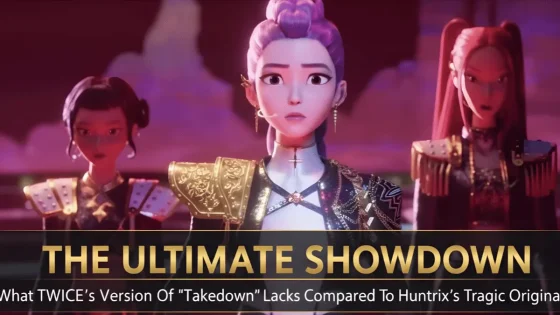
For any true fan of KPop Demon Hunters, the soundtrack is a character in itself. It is a brilliant collection of high-energy anthems, emotional duets, and strategic battle cries. Yet, buried deep in the lore and the kpop demon hunters song cd tracklist is a fascinating detail that sparks endless fan debate: The vicious diss track, ‘Takedown,’ has two versions. One is sung by Huntrix. The other? By the real-world K-Pop superstars, TWICE.
For TWICE fans (ONCEs) and KPop Demon Hunters enthusiasts alike, the comparison is electrifying. TWICE’s version is pure, flawless K-Pop perfection—a polished, aggressive anthem that is a masterclass in modern pop production. The Huntrix version, however, is something far more complex: it’s a lie.
The difference between the two tracks is the difference between professional execution and profound, narrative necessity. TWICE sings a brilliant diss track; Rumi sings a song of internal self-hatred that nearly destroys her soul and the entire rumi zoey mira trinity.
Why was the Huntrix rendition of ‘Takedown’ a necessary narrative flaw? And what essential, fatal ingredient did the perfectly executed TWICE version lack? We are diving deep into the psychology of the song, revealing how the hateful kpop demon hunters song lyrics of the original track represented the “Wrong Way” that forced Rumi toward her final, glorious act of self-acceptance and transformation.
I. The Wrong Way: Huntrix’s Internal Crisis in the Song ‘Takedown’
The entire film is built on Rumi’s struggle to break free from the “Wrong Way” of solving her problem—the shame she felt over her half-demon heritage and the spreading demonic patterns on her skin. Huntrix’s decision to record and perform ‘Takedown’ was the absolute peak of this flawed strategy.
Thematic Failure: Destruction Over Synthesis
The central theme of KPop Demon Hunters is that the solution to life’s chaos is acceptance; that “the dark and the light meet” to achieve unity and the stability required for the Golden Honmoon shield.
‘Takedown’ failed this thematic test spectacularly. The song’s kpop demon hunters song lyrics are filled with aggression and destructive finality aimed at the Saja Boys and all demons: “I’ll crush you and carve it in,” and “I’m here to end your soulless life and watch you die-ie-ie.”
-
The Psychological Mirror: For Rumi, singing a song about utterly destroying demons was a subconscious attempt to violently destroy the demon side of herself—the very demonic patterns she was desperately trying to hide. The song was an anthem of self-hatred, not power.
-
The Tonal Dissonance: Rumi’s discomfort with the song was palpable. While it was musically high-energy, it was emotionally poisonous, contributing directly to her descending spiral of internal conflict. This aggressive path pushed her further away from the genuine healing power of her true rumi song voice.
The Huntrix version is a record of pain. It is the sound of a hero choosing the wrong weapon, a choice that created a fissure the villain, Gwi-Ma, could easily exploit.
The Contrast: TWICE’s Power vs. Rumi’s Conflict
The TWICE version, while a technical marvel, entirely misses this essential psychological context.
Difference 1: The Weight of Internal Shame. When TWICE sings ‘Takedown,’ they sing a perfect, fierce diss track aimed at external rivals. They sing with conviction and unity. When Rumi sings it, she sings against the demonic patterns on her own neck. Her performance is choked by the shame she carries, contributing to her failing voice. The Huntrix track is a beautiful song delivered by a broken voice; the TWICE track is a beautiful song delivered by flawless health. The flaw in the Huntrix version is its narrative necessity—it had to sound like a temporary, painful tactic, which is the key distinction a real K-Pop fan appreciates.
II. The Missing Ingredient: Why the Psychological Flaw is the True Power
The most crucial difference between the two versions lies in the psychological and relational consequences the song triggered within the fictional universe.
Difference 2: Division vs. Unity (The Rumi Zoey Mira Fracture)
The Huntrix performance of ‘Takedown’ led directly to the near-collapse of the rumi zoey mira trinity.
-
The Emotional Fallout: The high-stress, high-hate energy of the track fueled the simmering tensions between Rumi and Mira. When Mira confronted Rumi about her secrecy, Rumi used the same aggressive, defensive energy of ‘Takedown’ against her friend, shattering their trust and allowing the demons to succeed in stealing souls.
-
TWICE’s Unity: The TWICE version, performed by a real, harmonious group, is a sound of perfect K-Pop unity. It has no thematic dissonance, no internal shame, and no psychological baggage. It is perfect external music. The Huntrix version, by contrast, is the sound of disunity, a necessary step in the story that had to fail to force Rumi toward her emotional climax.
Difference 3: The Antagonist’s Tool (Jinu’s Mirror)
The Huntrix version of ‘Takedown’ is essential because it sets up the tragic redemption of Jinu kpop demon hunter.
-
The B-Story Setup: Jinu, tormented by 400 years of shame, was Rumi’s dark mirror. He understood Rumi’s pain because he carried the ultimate guilt. The solution that healed Rumi’s voice was confession to Jinu, an act of empathy that completely rejected the aggressive philosophy of ‘Takedown.’
-
The Fandom Bridge: The contrast between the two rival tracks—the hateful ‘Takedown’ and the manipulative kpop demon hunters songs your idol—is the fuel for the kpop demon hunters full movie analysis. TWICE’s version is an external tribute; the Huntrix version is the emotional core of the film’s conflict. This contrast attracts real K-Pop fans, who appreciate the complex layers of storytelling and search for kpop demon hunters song lyrics to dissect the psychological warfare.
This deep dive into the kpop demon hunters lore, contrasting the real K-Pop star performance with the fictional character’s emotional breakdown, is a powerful tool for driving engagement and curiosity.
III. The Path to Acceptance: From Hate Song to Healing Song
The greatest failure of ‘Takedown’ was its inability to heal. Its ultimate purpose in the narrative was to be rejected, paving the way for the true, powerful rumi song of self-acceptance.

The Musical Salvation: What It Sounds Like
The final anthem, ‘What It Sounds Like,’ is the ultimate counter-anthem to the aggression of ‘Takedown.’ It is the sound of Rumi fully accepting the darkness (the demonic patterns) and embracing the truth.
-
Rejection of the Lyrics: The final kpop demon hunters song lyrics explicitly reject the hate of the diss track: “I tried to fix it / Tried to fight it / My heart was divided.” Rumi realizes that the Takedown mentality was the mistake.
-
The Leit Motif of Healing: Even the musical score rejects ‘Takedown’. The final song reclaims the melody of ‘Golden’ (the song of initial shame) and uses it with power, proving that Rumi’s voice is healed by truth, not aggression.
This thematic resolution ensures that the rumi zoey mira trinity achieves its full power—the Queen Rumi in Battle Mode transformation, with her demonic marks glowing gold—only after abandoning the philosophy of Takedown.
IV. The Digital Legacy: Linking K-Pop Perfection to Fandom Immersion
The existence of both the Huntrix and TWICE versions of Takedown creates a massive bridge between the real K-Pop world and the fantasy universe, fueling digital content and merchandise searches.
Digital Immersion: KPop Demon Hunters Games and OST
Fans actively use the music to engage with the lore, recognizing the difference between the two versions’ energy:
-
Rhythm Challenges: The fast, aggressive rhythms of ‘Takedown’ (both versions) are highly popular in kpop demon hunters magic tiles 3 and kpop demon hunters piano game challenges. Players master the complex choreography, whether imagining the flawless TWICE moves or the internal struggle of Rumi.
-
Merchandise Aesthetics: The distinction drives demand for specialized aesthetics. Fans creating the rumi kpop demon hunters golden costume look are celebrating the post-Takedown, acceptance aesthetic. The use of black kpop demon hunters leather is seen as the armor of the Takedown era. The intricate zoey shin kal weapons and mira zoey rumi sword props are essential for recreating the choreography of this high-intensity battle period.
This high engagement—from kpop demon hunters coloring to analyzing jinu and rumi wallpaper scenes—proves that the film’s success lies in its sophisticated, multilayered storytelling.
V. Conclusion: The Power of Truth Over Polish
The final verdict on the TWICE version of ‘Takedown’ is simple: it is flawless K-Pop excellence, a true tribute to the genre. But it lacks the one ingredient that makes the Huntrix version a masterpiece: tragic necessity.
The Huntrix version is the sound of a hero making a mistake, of a powerful voice being muted by shame. It is the necessary flaw that forces Rumi toward her final, beautiful truth. The TWICE version is the perfect song the rumi zoey mira trinity wished they could sing; the Huntrix version is the broken song they had to sing to save the world.
The ultimate takeaway for K-Pop Demon Hunters fans is that courage isn’t found in a perfectly polished diss track, but in the vulnerable, authentic voice that chooses self-acceptance over self-hatred. The emotional depth of Rumi’s journey ensures that her flawed, struggling song will always be the most potent anthem in the entire kpop demon hunters soundtrack.

روايات بدون إنترنت
اقرأ رواياتك المفضلة في أي وقت وأي مكان
هل أعجبتك هذه الرواية؟ يمكنك الآن الاستمتاع بقراءة هذه الرواية وآلاف الروايات الأخرى بدون إنترنت من خلال تطبيقنا المجاني!