

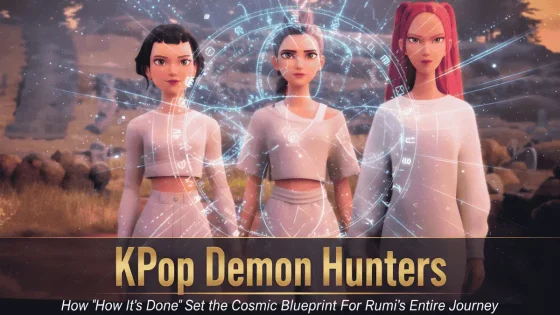
In the opening moments of KPop Demon Hunters, before the dazzling golden costume aesthetic and the high-stakes battle against the Saja Boys even begin, a voice sets the stage. As the camera sweeps over the stadium and the rumi zoey mira trio prepares to leap into action, the soundtrack drops the essential rumi song that explains the entire universe: ‘How It’s Done.’
This track is more than just a brilliant opening number; it is the thematic premise of the entire film, a philosophical thesis disguised as a K-Pop anthem. Every line of the kpop demon hunters song lyrics serves as a narrative prophecy, defining Rumi’s ultimate challenge and foretelling the solution that she must embrace to achieve the Golden Honmoon shield.
Why did the creators embed the film’s deepest meaning in the opening chorus? And how does one seemingly simple lyric—“until the dark and the light meet”—set the entire emotional and cosmic trajectory for Rumi’s struggle with her demonic patterns and the ultimate sacrifice of Jinu? We are diving deep into the powerful message of ‘How It’s Done,’ revealing how this song laid the unbreakable foundation for the entire saga.
KPop Demon Hunters
I. The Prophetic Chorus: Setting the Rites of Passage Trajectory
KPop Demon Hunters is structurally classified as a “Rites of Passage” story, where the hero’s victory depends entirely on overcoming an internal, personal flaw—in Rumi’s case, the shame of her mixed heritage. ‘How It’s Done’ is the song that introduces this theme, outlining the philosophical rules Rumi must eventually obey.
The Problem and the Promise
The opening verses establish the mission’s scope: the world is under attack by demons (like those later led by Mystery Saja), and the only defense is the Honmoon shield, powered by the collective hope and courage found in music. The ultimate goal is the Golden Honmoon, the eternal shield.
But the chorus of ‘How It’s Done’ reveals the deeper, thematic requirement for achieving that permanent peace:
Hear our steadfast voice Till our song defeats the night Makes fear afraid to breathe Until the dark and the light meet
-
The Muted Voice: Rumi’s great flaw is immediately foreshadowed here. She is the voice of the unit, but her voice fails because she is operating from the Wrong Way—trying to conceal the dark side of herself (her demonic patterns). The shame makes her fear the dark part of her identity, which is the antithesis of the song’s promise.
-
The Unbreakable Rule: The core phrase, “Until the dark and the light meet,” is the cosmic law Rumi spends the whole film fighting against. Her journey is about accepting that the darkness (the demonic patterns) and the light (her human hero role) must merge to create true power. Until she accepts this, the Honmoon will remain weak.
The Contrast of the Wrong Way: The Lie of Concealment
This powerful opening song is quickly betrayed by the actions of Rumi’s guardian, Celine, who insists on a philosophy of secrecy and division. The rumi song preaches synthesis, but the guardian preaches fear.
-
The Visual Lie: Rumi is forced to adopt kpop demon hunters leather gear and long coats to hide the spreading demonic marks—a visual representation of her trying to prevent the dark and the light from meeting.
-
The Musical Flaw: This internal struggle is what makes her voice fail when singing the subsequent perfection anthem, ‘Golden.’ The perfect notes of ‘Golden’ were impossible to hit while her soul was rejecting the truth preached in ‘How It’s Done.’
The very first song establishes the inevitable tension: Rumi must either live up to the song’s prophetic promise or suffer the catastrophic consequences of her secrecy.
II. The Musical Blueprint: How the Song Structured Rumi’s Emotional Breakdown
‘How It’s Done’ acts as a thematic compass, providing the roadmap for every subsequent crisis Rumi faces, from her internal shame to her external battles against Jinu.

1. The Confrontation with Hate: Rejecting ‘Takedown’
The song ‘How It’s Done’ guides the audience’s understanding of why the aggressive diss track ‘Takedown’ had to fail.
-
The Counter-Philosophy: ‘Takedown’ was filled with lyrics of violent destruction and hatred (“I’ll crush you and carve it in”). This philosophy was the opposite of the “dark and the light meet” message. Rumi’s deep discomfort with the hate-filled song was her soul recognizing that aggression was not synthesis.
-
The Unity Failure: The destructive energy of ‘Takedown’ fueled the emotional fracture between Rumi and Mira, leading to their schism on the train and proving that hatred (the Takedown mentality) could only lead to failure, just as the opening song warned.
2. The Healing Conversation: Embracing Vulnerability
The core philosophy of ‘How It’s Done’ is finally vindicated during Rumi’s meeting with Jinu, the conflicted demon whose 400 years of shame mirrored her own.
-
Jinu as Synthesis: Jinu‘s tragedy was his failed attempt to erase his dark past. Rumi realizes that sharing her shame with Jinu—the ultimate symbolic merging of hero and villain—healed her voice. This intimate, honest conversation fulfilled the mandate of ‘How It’s Done’ before the final battle even started.
-
The Song ‘Free’: The duet ‘Free,’ sung by Rumi and Jinu, is the musical celebration of this emotional breakthrough, representing their personal liberation and confirming that they have both chosen the path of truth promised in the opening lyrics.
III. The Climax of Synthesis: ‘What It Sounds Like’ as the Answer
The final, magnificent rumi song, ‘What It Sounds Like,’ is the ultimate resolution of the thematic premise laid down by ‘How It’s Done.’
The Lyrical Fulfillment: The Light and Dark Unite
The closing verses of ‘What It Sounds Like’ are the lyrical confirmation that Rumi has finally achieved the synthesis required by the opening anthem.
-
The Scars as Beauty: Rumi sings: “But now I see all the beauty / In the broken glass / The scars are a part of me.” The scars (the demonic patterns) are the “dark” side, and the acceptance is the “light” side. By embracing them both, she finally fulfills the opening song’s prophecy.
-
Queen Rumi in Battle Mode: This synthesis is made physical and visual. Her demonic patterns glow gold, transforming her into Queen Rumi in Battle Mode and allowing the rumi zoey mira trinity to harness their full power. The seamless glow is the visual proof that Rumi has achieved the ultimate balance and is ready to create the Golden Honmoon.
The Cosmic Conclusion: The Unstable Gold
Even though Rumi achieves personal synthesis, the Honmoon shield remains un-golden, proving that the cosmic goal is more difficult than the personal one.
-
The Missing Element: This failure means that while Rumi solved her part of the thematic premise, the collective unity is incomplete. The missing Qilin element, linked to the Four Guardians theory, is the final structural component required to truly fulfill the “dark and light meet” mandate on a universal scale.
-
The Sequel’s Promise: The fight against Mystery Saja in the sequel will be the final push to achieve the true synthesis the original song demanded, ensuring the rumi song has one final, glorious chapter left to sing.
IV. The Digital Foundation: How the Theme Fuels KPop Demon Hunters Games
The profound thematic premise laid out in ‘How It’s Done’ is the reason the film has generated such deep and complex engagement in the digital sphere, where fans seek to master the lore.
Gaming the Theme: KPop Demon Hunters Games and Logic
The theme of balance and synthesis is central to the interactive experience:
-
Rhythm Challenges: The tracks for kpop demon hunters magic tiles 3 and kpop demon hunters piano game often incorporate the rhythmic shift between the initial chaotic energy of the fight and the final harmony, forcing players to master the musical balance required by the song.
-
Lore Immersion: Kpop demon hunters rp and kpop demon hunters quiz forums constantly debate the ethical implications of the Saja Boys’ manipulative songs and the morality of Jinu’s sacrifice, all guided by the fundamental rule laid down in ‘How It’s Done.’
-
Aesthetic Searches: The aesthetics of unity drive searches for mira zoey rumi hunterx demon hunters costumes and items like kpop demon hunters earrings cuff and rumi kpop demon hunters necklace, which symbolize the tight bond necessary to achieve the Golden Honmoon.
The consistency of the theme, established from the first note of ‘How It’s Done,’ ensures that every subsequent plot development feels earned, logical, and emotionally resonant.
V. Conclusion: The Final Word on How It’s Done
‘How It’s Done’ is more than an introduction; it is the philosophical cornerstone of KPop Demon Hunters. It is the initial, powerful statement that guides Rumi through secrecy, shame, and self-doubt.
The rumi song demanded that the dark and the light meet, and by the film’s climax, Rumi had achieved that impossible synthesis—transforming her shame into power, and her brokenness into beauty. The song’s power continues to resonate because it offers a universal truth: the key to achieving any great victory, from defeating a Demon King to overcoming personal challenges, is accepting every single part of who you are. The sound of that acceptance, established in the opening anthem, is the ultimate power in the KPop Demon Hunters universe.

روايات بدون إنترنت
اقرأ رواياتك المفضلة في أي وقت وأي مكان
هل أعجبتك هذه الرواية؟ يمكنك الآن الاستمتاع بقراءة هذه الرواية وآلاف الروايات الأخرى بدون إنترنت من خلال تطبيقنا المجاني!