

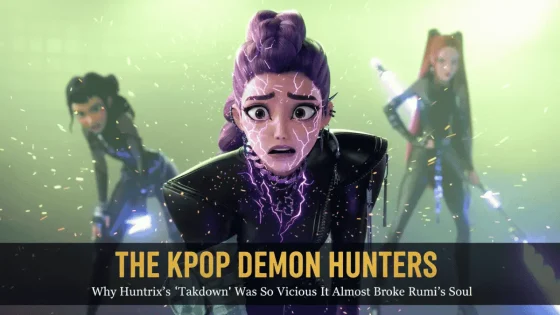
The KPop Demon Hunters excel at blending dazzling pop perfection with raw martial combat. But their biggest flaw wasn’t an external monster; it was an internal conflict about how to fight.
When the manipulative Saja Boys, led by the tragic Jinu, began stealing fans and souls with their deceptive music, Huntrix responded with aggression. Their answer was the hard-hitting, fierce diss track: ‘Takedown.’
Musically, it’s a brilliant, high-energy KPop banger. Lyrically, however, it is filled with raw, unvarnished hatred—declaring war not just on the demons, but on the very idea of coexistence. The kpop demon hunters song lyrics include chilling lines like, “I’ll crush you and carve it in” and “I’m here to end your soulless life and watch you die-ie-ie.”
Why did Rumi, the protagonist whose ultimate destiny was to unite light and dark, sing a song filled with such brutal finality? The truth is, she barely could. The hateful lyrics of ‘Takedown’ represented the “Wrong Way” of fighting—a philosophy that created a deep, internal split in Rumi’s soul, pushing her closer to collapse and nearly destroying the rumi zoey mira trinity from the inside out.
We are diving deep into the fascinating tonal dissonance of ‘Takedown,’ revealing how this aggressive track was a necessary narrative mistake that forced Rumi toward her final, powerful act of self-acceptance and transformation.
The KPop Demon Hunters
I. The Wrong Weapon: Why Aggression Contradicted Rumi’s Destiny
The central theme of The KPop Demon Hunters is clearly defined by the Rites of Passage narrative structure: the solution is acceptance, not destruction. The hero must realize that “the dark and the light meet” to achieve the Golden Honmoon and eternal balance.
The Poison of the Lyrics: Fighting the Self
‘Takedown’ failed the thematic test of the film. While the Saja Boys were a genuine threat, The KPop Demon Hunters response was fueled by a destructive energy that mirrored Rumi’s internal crisis.
- Destruction, Not Synthesis: The kpop demon hunters song lyrics of ‘Takedown’ preach absolute finality—crushing and ending the opponent’s life. This philosophy directly contradicts Rumi’s struggle. Rumi was trying to hide or destroy her own dark side—the demonic patterns that represented her heritage. Singing a song about utterly destroying demons was, psychologically, an attempt to violently destroy a part of herself.
- The Muted Voice: Rumi’s discomfort with the hate-filled lyrics contributed to her declining mental state. Her voice was already failing due to the shame and secrecy she carried, and singing a song that demanded hatred only deepened the fracture in her soul, pushing her farther from the genuine power of her rumi song voice.
The song, therefore, was a narrative misstep—a “Wrong Way” tactic in Rumi’s Rites of Passage journey. It was a symptom of the panic the rumi zoey mira trinity felt as their fan base was being stolen by the deceptive kpop demon hunters songs your idol anthem.
The Antagonist’s Lesson: Jinu’s Absence of Hate
The failure of ‘Takedown’ is amplified by the philosophy of The KPop Demon Hunters. Jinu‘s motive was not hatred, but shame over his past betrayal, driving his desperate quest for memory erasure.
- Mirroring the Pain: When Rumi finally meets Jinu, she realizes their core problem is shared: shame. Jinu‘s 400 years of guilt mirrors Rumi’s present-day internal split. The solution they find—confession and empathy—is the complete opposite of the destructive aggression found in the lyrics of ‘Takedown.’
- The True Counter: The true counter-anthem wasn’t ‘Takedown’; it was the ultimate truth delivered by the final rumi song, ‘What It Sounds Like,’ which embraced the brokenness rather than demanding perfection.
II. The Fracture Within: How the Song Shattered the Trinity
The aggression of ‘Takedown’ didn’t just feel wrong to Rumi; it fueled the breakdown of trust within the Huntrix unit, making them vulnerable to the external threat.
The Train Fight: Shame Made Manifest
The internal tension created by Rumi’s secrecy and the aggressive energy of their fighting songs exploded during the battle on the train. Mira, the honest, fiery dancer, confronted Rumi about her concealment.
- The Flaw in Mira: Mira’s righteous anger was a reaction to Rumi’s withdrawal and secrecy—the emotional fallout of the Old Way of doing things. However, her anger was unmanaged and destructive.
- Rumi’s Projection: Trapped by her lie, Rumi used the same destructive energy of ‘Takedown’ against her friend, lashing out at Mira’s insecurities and pushing the blame onto her.
This moment of internal chaos—where the rumi zoey mira bond shattered—allowed the demons to slip past the KPop Demon Hunters and successfully harvest the souls of the passengers. The film explicitly links their disunity (fueled by Rumi’s shame and aggressive tactics like ‘Takedown’) to their mission failure.
The Wise Silence of Zoey
Zoey, the grounded strategist and songwriter, is the structural anchor of the group. While Mira reacted with fire, and Rumi struggled with shame, Zoey likely observed the destructive energy of the fight.
- The Element of Earth: Zoey’s stability (linked to her Earth Trigram power and her symmetrical zoey shin kal weapons) makes her immune to the emotional chaos that gripped the other two. Her later focus would be on writing the true anthem, ‘What It Sounds Like,’ which finally integrates the truth Rumi discovered.
- The Aesthetic of Balance: Even Zoey’s aesthetic—her simple kpop demon hunters zoey yellow jacket and functional kpop demon hunters leather gear—contrasts with the hyper-emotionalism of the diss track, reinforcing her role as the balanced core needed to correct the imbalance caused by Rumi’s hate song.
The failure of the Honmoon shield to turn gold at the end of the film is the lingering physical sign of the disunity created by Rumi’s concealment and the aggression of ‘Takedown’.

The Musical Journey: From Takedown to Synthesis
The film’s genius is in using music to chart Rumi’s personal transformation—a journey that required abandoning the Hate Song for the Truth Song.
The Rejection of Aggression
Rumi’s internal rejection of the kpop demon hunters song lyrics in ‘Takedown’ was the first step toward finding her true voice. Her subsequent conversation with Jinu provided the emotional breakthrough.
- The Healing Note: Rumi’s voice was instantly healed when she chose truth over the destructive path of the hate song. The power came not from external fighting, but from internal honesty.
- The Song of Freedom: The duet ‘Free’ (sung by Rumi and Jinu) serves as the direct emotional counterpoint to ‘Takedown.’ While ‘Takedown’ represented containment and destruction, ‘Free’ represented liberation and emotional atonement, sealed by Jinu’s final sacrifice.
The Ultimate Synthesis: Reclaiming the Melody
The final anthem, ‘What It Sounds Like,’ is the sound of Rumi completely rejecting the philosophy of ‘Takedown’:
- The Lyrical Conclusion: The powerful final kpop demon hunters song lyrics explicitly reject the anger of the diss track, stating: “I tried to fight it / My head was twisted / My heart divided.” And the final acceptance: “But now I see all the beauty / In the broken glass / The scars are a part of me.” Rumi realizes that the solution was integrating the dark, not destroying it.
- The Musical Leit Motif: Even musically, the final song conquers the past. The central melody of ‘Golden’ (the song that failed due to shame) is reclaimed and sung with power in the final chorus of ‘What It Sounds Like,’ proving that Rumi’s reclaimed voice has rejected the aggressive path of ‘Takedown’ for the harmonious path of self-acceptance.
IV. The Fandom’s Final Verdict: Aesthetic and Digital Engagement
The contrast between the aggressive energy of ‘Takedown’ and the unity of ‘What It Sounds Like’ fuels high engagement in the digital fandom, where fans analyze the two extremes of Huntrix’s strategy.
The Aesthetic of Battle vs. Acceptance
- Aggression Aesthetic: The Takedown era aesthetic is focused on fierce, high-contrast black and kpop demon hunters leather gear. This look remains popular for kpop demon hunters wallpaper and kpop demon hunters drawing due to its raw energy.
- Acceptance Aesthetic: The What It Sounds Like aesthetic is the iconic Queen Rumi in Battle Mode transformation—where the demonic patterns glow gold. This look symbolizes the corrected strategy and drives high demand for rumi kpop demon hunters golden costume replicas and mira zoey rumi hunterx demon hunters costumes kits.
Gaming the Conflict
The emotional dissonance between the songs is used as a core mechanic in kpop demon hunters games:
- Rhythm Challenges: The fast, aggressive rhythms of ‘Takedown’ are among the most difficult tracks in kpop demon hunters magic tiles and kpop demon hunters piano game, symbolizing the chaos of Rumi’s internal conflict.
- Lore Debates: Kpop demon hunters rp and kpop demon hunters quiz communities constantly debate the ethical flaw of the song, analyzing whether the hate in the lyrics was necessary for the rumi zoey mira trinity to recognize the error of their ways.
V. Conclusion: The Power of Truth Over Hate
‘Takedown’ was the powerful, painful mistake that almost destroyed Huntrix. Filled with lyrics of finality and destruction, the song represented the “Wrong Way” for Rumi to deal with her inner shame. By choosing to sing a song of hate against her enemies, she was simultaneously singing a song of self-hate against her own demonic patterns.
The eventual triumph of the final rumi song proved that the greatest power in the KPop Demon Hunters universe is not found in the crushing force of aggression, but in the vulnerable, unifying power of truth and self-acceptance. The journey from the destructive rhythm of ‘Takedown’ to the healing harmony of ‘What It Sounds Like’ is the beautiful, hard-won story of a hero who learned that to save the world, she first had to forgive herself.

روايات بدون إنترنت
اقرأ رواياتك المفضلة في أي وقت وأي مكان
هل أعجبتك هذه الرواية؟ يمكنك الآن الاستمتاع بقراءة هذه الرواية وآلاف الروايات الأخرى بدون إنترنت من خلال تطبيقنا المجاني!